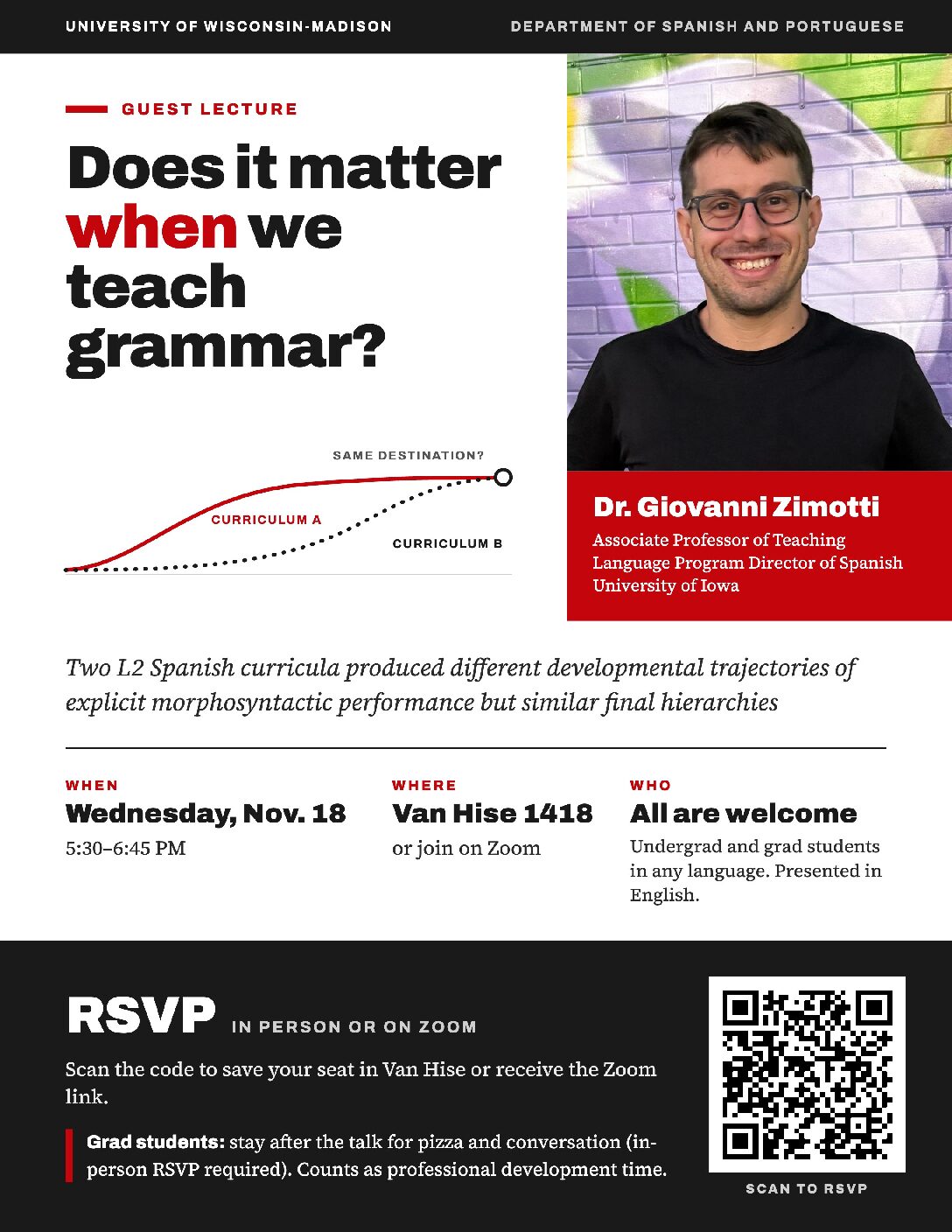

When should grammatical features be introduced and when should they be revisited within a language curriculum? In this talk, I present findings from a longitudinal study comparing the explicit morphosyntactic performance of 863 students enrolled in two L2 Spanish curricula that differed in instructional sequencing and timing. Group-level performance was examined across four semesters and eight assessment points. The results showed that the two curricula produced highly similar final hierarchies, and that explicit performance increased across four semesters in a very similar way in a stair-step pattern of development. The development of each feature was diverse, with the most common descriptive trajectory being flat-spike-plateau: a post-introduction spike followed by stabilization of the performance in the following semesters. The findings of this study are therefore consistent with the concept of equifinality: similar outcomes can be reached through different developmental trajectories. The findings also highlight the importance of investigating how performance develops over time.